Authored by: Johannes Strack
Business Development Manager
The Digital Shift in 2026: Are Your Nonprofit Systems Ready?
Digital transformation is no longer a future aspiration for nonprofits, it’s a present-day reality. As we move through 2026, charities are under growing pressure from rising demand, tighter funding, changing donor behaviour, and rapidly increasing expectations for digital engagement.
At mhance, we work with nonprofits across the UK to modernise their systems and help them prepare for what’s next. What’s becoming clear is this: digital readiness is no longer about experimentation or innovation for innovation’s sake. It’s about resilience, relevance, and impact.
So what does the digital shift really mean for nonprofits in 2026, and how ready are your systems to support it?
A Tougher Operating Environment Than Ever
The context matters. Nonprofits are operating under unprecedented strain.
Demand for services continues to rise, while funding is increasingly concentrated among fewer donors. Supporters are giving more intentionally, often in fewer moments, and are more selective about which organisations they engage with. At the same time, many charities are dealing with staff shortages, cost pressures, and reduced capacity.
This combination means teams are being asked to do more with less, while still delivering high-quality, responsive, and personalised experiences. Technology has a critical role to play, but only if it’s set up in the right way.
Fragmented Systems Are the Hidden Barrier
One of the biggest challenges holding charities back isn’t a lack of digital ambition, it’s fragmented systems.
Many organisations still rely on separate tools for fundraising, finance, service delivery, grants, and reporting. When these systems don’t talk to each other, data becomes siloed, reporting is manual, and leadership lacks a single, reliable view of the organisation.
The knock-on effects are significant. Teams fall back on spreadsheets and workarounds, slowing everything from campaign analysis to compliance. Automation becomes difficult and introducing AI safely and effectively feels out of reach.
Being digitally ready isn’t just about adopting modern tools. It’s about fixing these foundations, integrating systems, improving data quality, and reducing manual processes, so technology works for you, not against you.
The Digital Trends Shaping Nonprofits in 2026
Across the sector, several digital trends are now impossible to ignore.
Cybersecurity is mission-critical
Protecting supporter and beneficiary data is fundamental to trust. Cybersecurity is no longer just a compliance requirement; it’s part of your organisation’s credibility and reputation.
Digital and AI governance is rising up the agenda
As AI becomes more embedded in daily operations, charities are recognising the need for stronger governance, accountability, and digital expertise at leadership and trustee level.
Data is a strategic asset
There’s a growing divide between organisations with unified, well-governed data and those without. Insight, automation, and AI all depend on trusted, connected data.
Digital engagement expectations are accelerating
Supporters increasingly expect the same ease, speed, and responsiveness from charities that they experience in the commercial world. For many nonprofits, this gap between expectation and reality is widening.
AI is moving from experimentation to mainstream
AI is no longer a fringe topic. It’s reshaping expectations around responsiveness, personalisation, and capacity, and charities need to actively plan for its role in their future.
Digital-First Giving Is Now the Baseline
One of the clearest shifts is in how people choose to give.
Donors now expect fast, frictionless digital donation experiences, particularly on mobile. Influenced by everyday digital services, supporters want minimal steps from intent to completion, with seamless payment options and immediate confirmation.
Modern digital fundraising is designed to remove friction: fast-loading forms, suggested ask amounts, and simple user journeys. But the experience doesn’t stop at the donation page.
When online giving is properly integrated with your core systems, each donation becomes part of a single supporter record. This enables better segmentation, more personalised journeys, and cleaner data, all of which support stronger fundraising outcomes over time.
Digital fundraising is also inherently multi-channel. Supporters engage across email, social media, SMS, websites, and peer-to-peer platforms, often moving fluidly between them. To stay relevant, charities need to meet people where they are, with consistent and intuitive experiences across every touchpoint.
Agentic AI: Extending Capacity Without Growing Headcount
This digital-first shift is being accelerated by AI, particularly through the emergence of agentic AI.
Unlike traditional chatbots, agentic AI can take action. These AI agents can be trained to work autonomously, making decisions and executing tasks based on organisational goals.
In practice, this opens up powerful use cases for nonprofits:
- 24/7 supporter-facing agents that answer questions, provide donation information, or support volunteers
- Automated triage and routing for service users
- Routine CRM updates and follow-up communications handled automatically
- Internal agents supporting HR, fundraising qualification, or knowledge sharing
For a sector under pressure, this matters. Agentic AI can help charities extend capacity, improve response times, and deliver more consistent experiences, without increasing headcount.
But AI only delivers value when the foundations are right. Without integrated systems, governed data, and clear processes, AI risks automating confusion rather than solving problems.
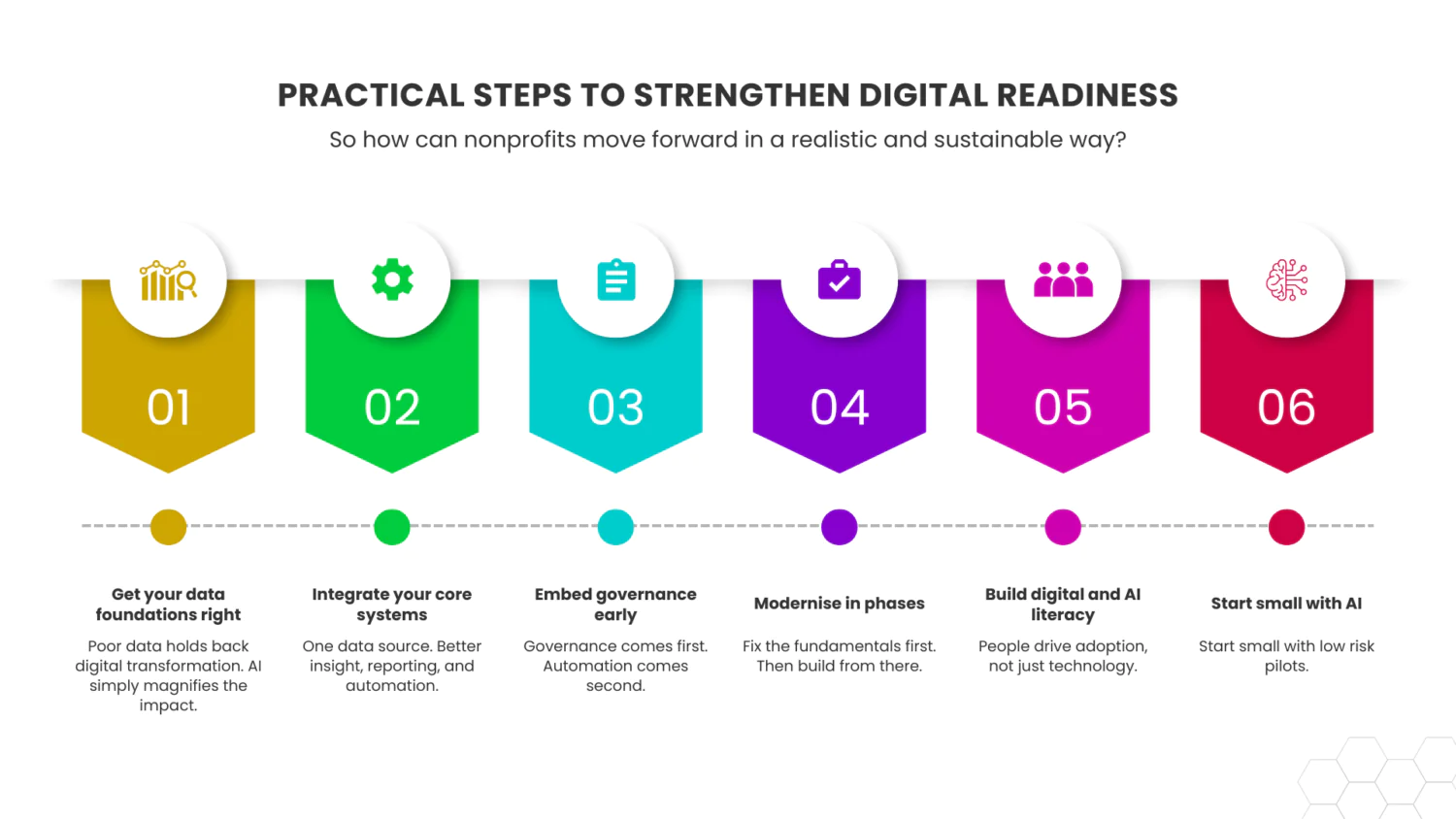
Practical Steps to Strengthen Digital Readiness
So how can nonprofits move forward in a realistic and sustainable way?
- Get your data foundations right
Data quality, access, and governance are the biggest barriers to digital transformation. AI and automation will only amplify what already exists, good or bad.
- Integrate your core systems
Fundraising, finance, service delivery, and grants should work together. A single source of truth unlocks better insight, reporting, and automation.
- Embed governance early
Digital, data, and AI governance shouldn’t be an afterthought. Clear policies, permissions, and accountability are essential before scaling automation.
- Modernise in phases
Focus on your biggest pain points first. Stabilise core platforms, then layer new capabilities over time to avoid disruption and unnecessary cost.
- Build digital and AI literacy
Technology adoption succeeds when people are confident using it. Training, change management, and trustee engagement are critical success factors.
- Start small with AI
Pilot contained, low-risk use cases, such as FAQs, volunteer queries, or internal support workflows, to demonstrate value quickly and safely.
Are You Ready for 2026?
Digital engagement is rising faster than ever, and supporter expectations are evolving just as quickly. Mobile-first giving, multi-channel engagement, and AI-powered responsiveness are no longer optional, they’re becoming the baseline.
The charities that thrive in 2026 and beyond will be those that invest in strong digital foundations today: integrated systems, trusted data, and a clear strategy for using technology to extend impact.
Digital readiness isn’t about chasing trends. It’s about building resilient, connected systems that allow your organisation to focus on what matters most, delivering meaningful change.
If you’d like to explore how mhance can support your digital journey, from integrated Microsoft platforms to AI-ready data foundations, we’d love to talk.